

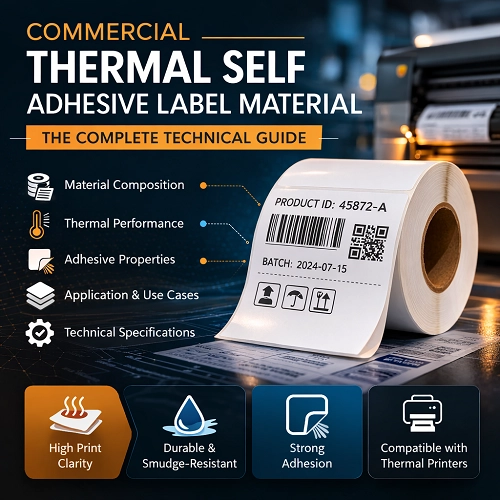
Commercial Thermal Self Adhesive Label Material: The Complete Technical Guide
What Is Commercial Thermal Self Adhesive Label Material?
Commercial Thermal Self Adhesive Label Material sits at the intersection of materials science, coating technology, and supply-chain logistics. In its simplest form it is a three-layer laminate — a thermally reactive facestock, a pressure-sensitive adhesive (PSA), and a silicone-coated release liner — yet the engineering decisions embedded in each layer determine whether a label will survive a cold-chain warehouse at −25 °C, pass under a 600 mm/s barcode scanner, or peel cleanly from a glass bottle in a high-humidity retail environment.
Global demand for self-adhesive labels continues to expand alongside e-commerce fulfillment volumes, pharmaceutical serialization mandates, and food-safety traceability regulations. According to market analysts, the global pressure-sensitive label segment is on track to surpass USD 50 billion in value within this decade, with direct thermal substrates claiming one of the fastest-growing sub-segments driven by inkless printing economics and just-in-time logistics needs.
This guide — informed by TGX Group's product range and technical specifications — walks through the full technology stack: from leuco-dye chemistry to cold-temperature adhesive formulations, from liner selection to sustainability-driven regulatory compliance. Whether you are a label converter benchmarking substrate options, a procurement manager evaluating supplier capabilities, or an engineer specifying materials for a new automated line, this resource is written for you.
Thermal Coating Chemistry: How Heat Becomes Image
The defining characteristic of direct thermal label material is its ability to produce a dark, high-contrast image without any ink, ribbon, or toner. Understanding the chemistry behind this reaction is essential for specifying the correct grade, troubleshooting image quality issues, and predicting long-term print stability.
The Leuco-Dye Reaction System
Modern thermal coatings rely on a three-component system dispersed in a polymer binder and coated onto the base paper or film substrate:
Leuco Dye
A colorless (reduced) dye precursor — commonly Crystal Violet Lactone (CVL) or ODB-2 — that transitions to a deeply colored form upon protonation. Controls final image color (typically black or blue-black).
Developer (Acid Source)
A solid organic acid — historically bisphenol A (BPA), increasingly replaced by BPA-free alternatives such as bisphenol S (BPS), D8, or Pergafast 201 — that protonates the leuco dye upon melting.
Sensitizer
A low-melting-point compound that creates a eutectic melt with the developer, lowering the reaction temperature to the practical range of 60–100 °C and sharpening the print threshold.
When the print head applies localized heat (typically 200–300 °C at the element surface for a fraction of a millisecond), the sensitizer and developer melt together, creating a liquid microenvironment in which the leuco dye dissolves and is protonated, forming its colored state. On cooling, the matrix re-solidifies around the colored dye molecules, locking the image in place.
Top Coating for Protection and Performance
Top coated thermal paper adds a transparent protective layer above the thermal coating. This overcoat serves multiple functions: it protects against chemical migrants (plasticizers, solvents, hand creams) that would otherwise bleach the image, improves head-wear resistance for the print element, and enhances surface gloss or matte aesthetics. The formulation — typically an acrylic or hybrid polymer — must be carefully balanced; too thick an overcoat insulates the thermal layer and degrades sensitivity, too thin provides insufficient protection.
TGX Group's Top Coated Thermal Self-Adhesive Label line uses precision coating technology to achieve the right balance of sensitivity, image durability, and surface workability for both desktop and industrial thermal printers.
"The top coat is not merely decorative — it is the chemical barrier that determines whether a barcode remains scannable for 6 months or 6 years."
BPA-Free and Phenol-Free Formulations
Regulatory pressure from the European Chemicals Agency (ECHA) and equivalent bodies has driven rapid adoption of phenol-free thermal developers. The EU's REACH regulation restricts BPA on thermal paper to concentrations below 0.02% by weight, effective since January 2020. BPS and novel developer compounds such as Pergafast 201 (4-hydroxy-4'-isopropoxydiphenylsulfone) and D8 have emerged as the primary alternatives, though ongoing toxicological evaluations continue to shape the regulatory landscape.
TGX Group's ECO Top Coated Thermal Paper is engineered to comply with these evolving standards, providing a safe and compliant substrate for food packaging, healthcare, and consumer-facing retail applications.
Label Construction: Anatomy of a Self-Adhesive Label
A commercial thermal self-adhesive label is a precision-engineered laminate. Each functional layer must be specified independently and must work in concert with the others to deliver consistent performance from the production roll through to the point of final application.
Facestock Selection
The facestock is the visible face of the label and the substrate on which the thermal coating is applied. For paper-based labels, the dominant options are:
| Facestock Type | Weight Range | Key Properties | Typical Use |
|---|---|---|---|
| Standard thermal paper | 60–80 g/m² | Good sensitivity, cost-effective | Retail POS, shipping labels |
| Top coated thermal | 75–90 g/m² | Chemical resistance, extended image life | Logistics, healthcare ID |
| Composite thermal | 80–100 g/m² | Enhanced durability, tear resistance | Industrial / outdoor labels |
| Thermal BOPP film | 50–60 μm | Waterproof, flexible, high clarity | Food, beverage, cold chain |
TGX Group's Composite Thermal Paper and Thermal BOPP represent the two ends of the durability spectrum, bridging paper economics with film performance.
Adhesive Science: The Bond That Makes or Breaks a Label
The pressure-sensitive adhesive layer is arguably the most technically complex component of a self-adhesive label. It must balance three competing properties: tack (immediate grab on contact), peel adhesion (sustained bond strength), and shear resistance (resistance to lateral displacement under load). These three properties are in fundamental tension with each other — formulating a PSA is always an engineering trade-off.
PSA Chemistry Platforms
Commercial PSAs for label applications fall into three primary polymer families:
Acrylic Emulsion PSA
The dominant platform for general-purpose labels. Water-based, solvent-free, and compatible with a wide range of substrates. Acrylic PSAs offer excellent UV and oxidation resistance, making them suitable for outdoor and long-life labeling applications. Their high-polarity backbone also provides good adhesion to difficult substrates such as HDPE and polypropylene.
TGX Group employs acrylic-based PSA platforms across its standard label material range, with Tg (glass transition temperature) tuned to application temperature ranges.
Hot-Melt Rubber PSA
Styrene-block copolymer (SBC) based systems — typically SIS (styrene-isoprene-styrene) or SBS — processed without solvents at elevated temperatures. Hot-melts are characterized by very high initial tack and cost-effective processing but have lower UV and heat resistance compared to acrylics. Widely used in cost-sensitive logistics and POS applications.
Functional Adhesive Grades
| Adhesive Grade | Application Temp. | Service Temp. | Key Feature |
|---|---|---|---|
| Standard Permanent | +5°C to +40°C | −20°C to +80°C | High tack, all-purpose logistics |
| Removable (Clean Peel) | +10°C to +40°C | −10°C to +60°C | No adhesive residue on removal |
| Freezer-Grade Permanent | −25°C to +10°C | −40°C to +25°C | Cold-room / frozen food labeling |
| High-Temperature Resistant | +15°C to +40°C | Up to +120°C (short-term) | Industrial process, autoclave |
| Food-Contact Compliant | +5°C to +35°C | −20°C to +60°C | Low-VOC, FDA/EU 10/2011 compliant |
"A freezer-grade adhesive must remain viscoelastic at −40 °C while developing sufficient tack to bond to a frost-covered polyolefin container in under two seconds on a high-speed line."
Adhesive Coat Weight and Uniformity
Coat weight (typically 12–25 g/m²) must be applied with exceptional uniformity across the web width. Variation greater than ±5% can manifest as inconsistent peel adhesion across a label roll, causing both application failures and downstream scanning problems. Modern slot-die and gravure coating methods achieve ±2–3% coat weight tolerance, which is the benchmark for quality commercial supply.
Key Specifications & Performance Parameters
Procurement engineers and label converters require a defined set of measurable parameters to qualify a thermal label material. The following table summarizes the key performance variables for TGX Group's Commercial Thermal Self Adhesive Label Material.
| Parameter | Standard Grade | Premium / Top-Coated | Test Method |
|---|---|---|---|
| Facestock basis weight | 60–80 g/m² | 75–90 g/m² | ISO 536 |
| Total caliper (laminate) | 165–200 μm | 190–240 μm | ISO 534 |
| Thermal sensitivity (Dmax) | ≥ 1.0 OD | ≥ 1.2 OD | MacBeth densitometer |
| Initial peel adhesion (180°) | ≥ 6 N/25mm | ≥ 8 N/25mm | FINAT FTM1 |
| Shear resistance | ≥ 24 h (1 kg, 25mm²) | ≥ 48 h | FINAT FTM8 |
| Release force (glassine) | 10–25 cN/cm | 10–20 cN/cm | FINAT FTM3 |
| Image stability (25°C, no UV) | ≥ 12 months | ≥ 24 months | ANSI MH10.8 |
| Roll width | 25–1,070 mm | 25–1,070 mm | Customizable |
| BPA content | Standard (BPS alt.) | BPA-free / Phenol-free | LC-MS/MS per EU REACH |
Parameters such as peel adhesion are measured according to FINAT (Fédération Internationale des fabricants et transformateurs d'Adhésifs et Thermocollants) standard test methods, which are the globally recognized benchmarks for pressure-sensitive label materials.
Film vs. Paper Substrates: Making the Right Choice
While paper-based thermal facestocks dominate by volume, synthetic film substrates are capturing share in high-performance segments. TGX Group offers a comprehensive Film Label Material range that includes PE, PP, and PET film options, each suited to distinct performance envelopes.
| Property | Paper Thermal | PP Film Thermal | PET Film Thermal |
|---|---|---|---|
| Water resistance | Low–Medium | Excellent | Excellent |
| Tear resistance | Low | Good | Excellent |
| Chemical resistance | Low | Good | Excellent |
| Cost index | 1.0× (baseline) | 2.0–3.0× | 3.0–5.0× |
| Recyclability | High (fiber) | Medium (PP stream) | Medium (PET stream) |
| Typical thickness | 60–120 μm | 50–80 μm | 25–50 μm |
| Conformability | Medium | Excellent (PE-like) | Low (rigid) |
TGX Group's PE Film, PP Film, and PET Film label materials cover this performance spectrum. For most commercial thermal applications, a 50# Transparent PP Film Self-Adhesive Label or the 50# Silver PP Film Self-Adhesive Label offers the best balance of performance and cost for demanding moisture and chemical environments.
Sustainability, Regulation & the Future of Thermal Labels
The label industry is undergoing a significant sustainability transition, driven by brand owner commitments, extended producer responsibility (EPR) regulations, and end-consumer expectations. Thermal self-adhesive labels sit at the intersection of multiple regulatory frameworks.
BPA and Phenol Restrictions
As noted above, the EU REACH Annex XVII restriction of BPA in thermal paper (effective January 2020, threshold 0.02% w/w) has driven wholesale reformulation across the supply chain. Regulatory scrutiny is now extending to BPS and other structural analogues, creating ongoing demand for novel, toxicologically characterized developer alternatives. TGX Group's ECO Top Coated Thermal Paper is formulated to meet current and anticipated regulatory thresholds.
Linerless Label Technology
Linerless labels — which replace the silicone-coated release liner with a silicone-treated facestock back — eliminate approximately 40% of label material waste by weight. While the technology has been commercially available for decades, adoption has accelerated as waste reduction targets become binding. Linerless thermal labels require modified printer feed mechanisms and a compatible non-stick platen coating, but offer compelling economics for high-volume logistics and POS environments.
Recyclable and Compostable Liners
Glassine and kraft paper liners are recoverable in paper recycling streams when the silicone coating weight is below thresholds set by industry bodies such as CEPI (Confederation of European Paper Industries). PET liner recycling is more complex but improving as chemical recycling infrastructure scales. TGX Group's sustainability commitments include advancing liner recyclability and reducing VOC emissions from coating processes.
Targanix: Committed to Sustainable Label Solutions
TGX Group actively develops BPA-free, phenol-free, and low-VOC thermal coating formulations aligned with global regulatory frameworks. Our sustainability program addresses raw material sourcing, coating chemistry, liner recyclability, and end-of-life waste reduction. We support customers in meeting REACH, RoHS, FDA, and food-contact compliance requirements for their specific markets.
Extended Producer Responsibility (EPR)
EPR schemes across the EU, UK, and increasingly in Asia-Pacific are placing financial obligations on label material producers and brand owners for the end-of-life management of packaging and label waste. This is creating commercial incentive to specify lighter-weight, more recyclable label constructions — driving innovation in thin liners, water-based adhesives, and single-polymer constructions.
Storage, Handling, and Quality Control
Improper storage is the leading cause of preventable quality failure in thermal label materials. The thermal coating is by design reactive — any premature exposure to heat, pressure, or chemical migrants will degrade sensitivity and image quality before the label reaches the printer.
Recommended Storage Conditions
Temperature
Store at 18–25 °C. Avoid storage near heat sources, direct sunlight, or external walls with high thermal mass. Every 10 °C above 25 °C approximately halves the remaining shelf life of the thermal coating.
Humidity
Target 45–65% relative humidity. High humidity causes moisture uptake by paper facestocks, leading to cockling, telescoping rolls, and poor print head contact. Low humidity increases static charge on film substrates.
Stacking & Pressure
Store rolls vertically or with core-to-core support. Excessive stacking pressure can cause flatspot deformation in the roll and permanent adhesive cold-flow ("ooze") at the roll edges.
Chemical Segregation
Keep thermal label stock away from solvents, plasticizers, and hydrocarbon vapors. Plasticizer migration from PVC pipes or flooring can migrate through liner and bleach the thermal coating within weeks.
Quality Control Parameters
Professional label converters and procurement managers apply incoming quality control (IQC) checks to each incoming batch. Key tests include:
- Optical Density (Dmax): Print a 100% density test patch on a reference printer at standard energy, measure with a reflectance densitometer. Dmax should be ≥ 1.0 for standard grades, ≥ 1.2 for premium top-coated.
- Background Fog (D0): Measure optical density of an unprinted area. D0 should be ≤ 0.06 to indicate no premature thermal activation during storage.
- Peel Adhesion: 180° peel test per FINAT FTM1 on a stainless steel panel at 300 mm/min, conditioned at 23 °C for 20 minutes after application. Minimum 6 N/25mm for standard permanent grades.
- Caliper: Measured per ISO 534 under 100 kPa pressure. Caliper uniformity (σ ≤ 2 μm) is critical for consistent die-cutting register in high-speed converting lines.
About Targanix — TGX Group
TGX Group, operating under the Targanix brand, is a specialized supplier of functional coated materials based in Jiaxing City, Zhejiang Province, China — one of the world's most developed hubs for specialty paper and label material manufacturing. The group's product portfolio spans three core categories: Release Paper, Self-Adhesive Material, and Speciality Papers.
Self-Adhesive Material Range
The self-adhesive portfolio includes Label Material, Prime Paper Label Material, Variable Information Paper, Film Label Material, and specialty Adhesive solutions covering permanent, removable, freezer-grade, and high-temperature grades.
Industries Served
TGX Group serves customers across multiple industries including logistics, retail, food packaging, healthcare, manufacturing, and e-commerce. Label converters, printing service providers, and OEM partners form the primary customer base, supplemented by direct supply to large-volume end-users.
Technology and Innovation
TGX Group's technology platform encompasses precision slot-die and gravure coating, multi-layer lamination, and in-line quality monitoring systems. The company's focus on coating formulation development — particularly BPA-free thermal chemistry and cold-temperature adhesive systems — positions it as a partner for technically demanding applications rather than a commodity volume supplier.


